An SME owner rarely begins with a technical category. The starting point is usually a practical frustration: enquiries take too long to answer, information is copied between systems, employees cannot find the latest document, or approvals disappear inside email threads.
Then the technology labels arrive. A vendor proposes a chatbot. A software platform promotes workflow automation. A colleague says the business needs an AI agent. All three can sound like different versions of the same promise: less manual work and faster service.
They are not interchangeable.
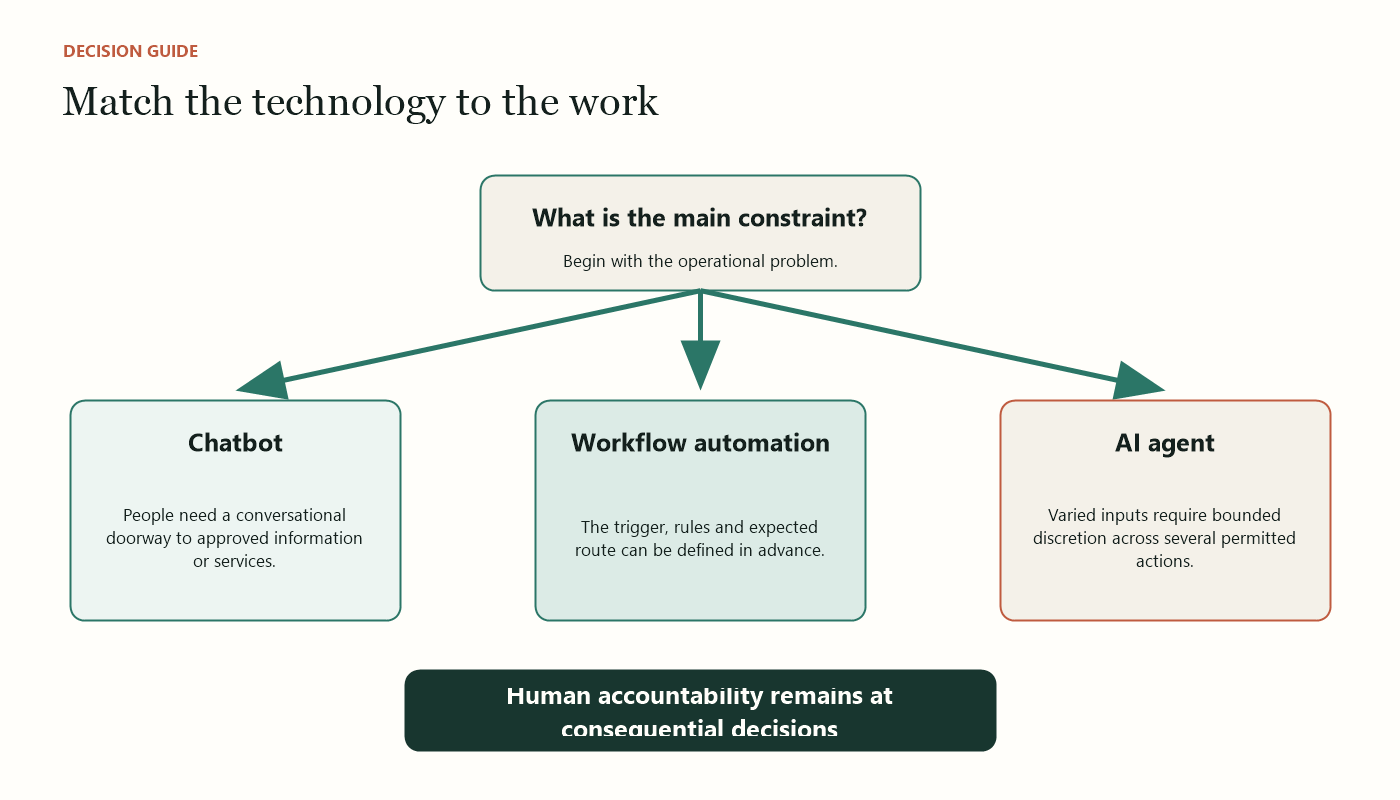
A chatbot is primarily a conversational interface. Workflow automation moves work through predefined steps. An AI agent can interpret a goal, choose among actions and use connected tools with some degree of autonomy. Each approach is useful, but each solves a different kind of problem and creates a different level of operational risk.
Choosing the wrong category can produce an impressive demonstration that never becomes a dependable business process. The better question is not, “Which technology is most advanced?” It is, “What kind of work are we trying to improve, and how much freedom should the system have?”
This guide provides a practical way for SME leaders to decide.
Start with the work, not the product
Before comparing tools, describe the operational problem in plain language. Identify the trigger, the information available at the start, the desired outcome, the exceptions and the person accountable for the result.
Consider a customer enquiry. The trigger is a submitted website form. The available information includes the customer’s name, company and description of the problem. The desired outcome may be a timely acknowledgement and an internal follow-up task. Exceptions include incomplete contact details, urgent complaints and requests outside the company’s scope.
That description is more useful than saying, “We need AI for sales.” It reveals that different parts of the work may need different mechanisms. A form and deterministic workflow can validate required fields. AI can summarise the free-text problem. A person can decide whether and how to pursue the opportunity.
Many effective systems are therefore combinations. The important decision is what role each component should play.
What is a chatbot?
A chatbot allows a user to interact with information or services through conversation. The conversation might appear on a website, in a messaging channel or inside an employee portal.
Traditional chatbots follow scripted paths. They ask a question, match the response to a known category and present a predefined answer. Modern AI chatbots can interpret more varied language and generate responses from approved information.
A chatbot is a good fit when the main problem is access. Customers may need answers outside office hours. Employees may struggle to find procedures across many documents. A conversational interface can make existing information easier to reach.
Useful SME examples include:
- answering common questions about services, opening hours or preparation requirements;
- guiding a customer to the correct form or department;
- helping employees search an approved policy or product knowledge base;
- collecting structured details before a person takes over; and
- providing order or appointment status from a connected system.
The chatbot should not pretend to know information it cannot access. It needs a clear scope, current source material and an escalation path. A polite answer is not necessarily a correct answer. If a question involves a complaint, a contractual commitment or sensitive personal data, the conversation may need to transfer to an authorised employee.
Choose a chatbot when conversation is genuinely the most convenient interface. Do not add one merely because the website looks more modern with a chat bubble.
What is workflow automation?
Workflow automation executes predefined rules when an event occurs. It is strongest when the path is repeatable and the business can describe what should happen in each situation.
A new form submission might create a record, notify an employee and schedule a reminder. An approved purchase request might be converted into an order and filed in the correct folder. A signed document might update a status and trigger onboarding tasks.
Workflow automation is usually more predictable than generative AI. If a field contains a particular value, the system follows the configured route. That makes the logic easier to test, explain and audit.
It is a good fit when:
- the trigger and expected output are clear;
- the same information is repeatedly copied or re-entered;
- rules can be stated without relying heavily on judgement;
- handovers between people or systems cause delays; and
- the organisation needs consistent records and timestamps.
Rules still require maintenance. A workflow can reliably execute an outdated process. It can also move bad data faster. Before automating, map the current process, remove unnecessary steps and define how exceptions return to a person.
For many SME problems, workflow automation should be the foundation. AI can then be added only where language, documents or ambiguity make fixed rules insufficient.
What is an AI agent?
An AI agent is designed to pursue an objective by planning or selecting actions, often using connected tools. Instead of responding only with text, it might search an approved knowledge source, create a draft, update a system or request an approval.
The key difference is discretion. A workflow follows a route that people designed in advance. An agent can choose among routes based on its interpretation of the situation.
That flexibility creates value when every case is not identical. It also increases risk. An agent with access to email, files, customer records or payment systems can make consequential mistakes at greater speed. Singapore’s Model AI Governance Framework for Agentic AI emphasises bounding an agent’s powers, maintaining meaningful human accountability, controlling access to tools and data, and training users to supervise the system responsibly.
Appropriate early use cases include:
- preparing a research brief from approved sources;
- assembling a draft response and supporting documents for review;
- triaging varied requests and proposing the next action;
- checking several systems to prepare a case summary; and
- coordinating low-risk internal tasks within strict limits.
An AI agent should not begin with unrestricted access and a broad instruction such as “manage customer service.” Start with a narrow objective, a short list of permitted tools and explicit approval checkpoints.
The practical comparison
Think about the three options across five dimensions.
1. Nature of the input
A chatbot handles questions and conversational input. Workflow automation handles events and structured data. An AI agent is useful when the input is varied and the system must interpret context before choosing an action.
2. Predictability
Workflow automation is normally the most predictable because its routes are predefined. A chatbot’s reliability depends on its knowledge and response controls. An agent is the least predictable because it may plan across several steps.
3. Ability to act
A basic chatbot provides information. A workflow performs configured actions. An agent may decide which actions to perform. The more freedom a system receives, the stronger its permissions, monitoring and approval design must be.
4. Maintenance burden
Chatbots require current source content and testing of unanswered questions. Workflows require rule, integration and exception maintenance. Agents require all of those controls plus evaluation of planning behaviour and tool use.
5. Consequence of failure
A chatbot might provide an incorrect answer. A workflow might create the wrong record or notification. An agent might perform several incorrect actions before a person notices. Risk is determined not by the label but by access, autonomy and business consequence.
A decision framework for SME leaders
Use the following sequence.
Choose workflow automation when the route is known
If employees agree on the trigger, rules and outcome, begin with a workflow. Examples include routing a form, issuing a standard reminder, filing an approved document or updating a status after payment.
Avoid using AI to make a process appear flexible when the business simply has not documented its rules.
Choose a chatbot when users need a better doorway
If the information already exists but customers or employees struggle to access it, consider a chatbot. Define the topics it may answer, show the source where useful and provide a visible route to a person.
Measure successful resolution, not the number of conversations.
Consider an AI agent when controlled discretion creates value
An agent may be justified when the work requires interpreting varied information and coordinating several steps. The business should be able to state why fixed rules are insufficient and why the additional flexibility is worth the additional oversight.
Begin in a preparation role. Let the agent gather, summarise and propose. Allow it to execute only low-consequence actions until testing demonstrates dependable performance.
Example: handling a new sales enquiry
Suppose a consultancy receives an enquiry describing an operational problem.
The chatbot can ask clarifying questions and explain what information is useful. The workflow can validate the submission, create a record, send a standard acknowledgement and assign a follow-up date. An AI assistant or agent can summarise the problem, identify possible service categories and draft questions for the consultant.
The consultant remains responsible for assessing fit, discussing confidential information, estimating effort and making commitments.
This design uses each technology for its strength. Conversation collects information. Rules maintain consistency. AI reduces reading and preparation time. Human judgement controls the commercial decision.
Questions to ask a vendor
Before purchasing a solution, ask:
- Which parts are deterministic rules and which parts use generative AI?
- What data can the system access, and how are permissions limited?
- Can it take actions without approval? Which actions?
- How does it respond when information is missing or contradictory?
- Can outputs show their source?
- How are errors, overrides and approvals recorded?
- Can the organisation export its data and configuration?
- What happens when a connected service is unavailable?
- How will the solution be tested before live use?
- Who maintains it after handover?
Clear answers matter more than an impressive demonstration.
Avoid the “one intelligent assistant” trap
It is tempting to imagine one assistant that understands the entire company. For most SMEs, that creates an unnecessarily large project and a difficult control problem.
A smaller design is usually stronger: one knowledge assistant for approved questions, one workflow for enquiry handling and one controlled AI step for summarisation. Each component has a named owner and measurable outcome.
Modular systems are easier to test and replace. They also make failures easier to contain. If the summary is wrong, the enquiry record and original submission still exist. If a chatbot cannot answer, it hands the conversation to a person rather than inventing a solution.
How to select the first project
Choose a process with enough repetition to produce evidence but not so much consequence that an early mistake would be serious. Establish a baseline for handling time, delays, rework and user experience.
Then write a one-page design:
- the problem and intended outcome;
- the trigger and required information;
- the role of rules, conversation and AI;
- prohibited actions;
- human approval points;
- exception routes;
- data and access limits; and
- measures for success.
Run representative cases, including incomplete and unusual examples. A system is not ready because it succeeds on the perfect demonstration. It is ready when the team knows how it behaves under normal variation and how it fails safely.
The right answer may be a combination
Chatbots, workflow automation and AI agents are not competing levels in a maturity ladder. An SME does not graduate from workflows to agents simply because agents are newer.
Use a chatbot when conversation improves access. Use workflow automation when rules can move work reliably. Use an AI agent when bounded discretion across several steps produces measurable value. Keep consequential decisions with accountable people.
The most effective solution is often less dramatic than the product pitch. It is a well-designed workflow with AI in one or two carefully chosen places. That approach is easier to explain, safer to operate and more likely to keep working after the novelty disappears.
Sources and further reading
- IMDA: Model AI Governance Framework for Agentic AI
- IMDA: Artificial Intelligence in Singapore
- NIST: AI Risk Management Framework
Want to make this practical for your business?
Start with the operational problem, the people involved and the outcome you need.