Customer enquiries appear to be an obvious use case for artificial intelligence. The work is repetitive, customers expect quick replies and many questions resemble one another. An AI assistant can operate outside office hours, search approved information and draft a response in seconds.
The difficulty is that “customer enquiry” describes very different situations.
“What time do you open?” has a stable factual answer. “Can you deliver to this postal code?” may require a current service-area check. “Why was my refund rejected?” involves an individual decision and potential dispute. “I feel unsafe using your product” requires urgency, empathy and accountable action.
Treating all four as the same automation problem creates risk. Refusing to use AI anywhere leaves useful efficiency on the table.
The practical answer is to classify enquiries by consequence and give AI a different role at each level. AI can answer some questions directly, prepare others for review and immediately transfer sensitive cases to a person.
Begin with the outcome, not the chatbot
Before selecting a product, describe what a successful enquiry process means.
It may include:
- acknowledging the customer promptly;
- understanding the request without unnecessary repetition;
- providing accurate and current information;
- protecting personal and confidential information;
- making commitments only with proper authority;
- recognising complaints, urgency and vulnerability;
- preserving a usable record; and
- escalating to the right employee with context.
An AI system is one component within this process. A conversational interface may collect information. A knowledge system may retrieve an approved answer. A deterministic workflow may create a case. A human may decide the remedy.
The business should judge the complete service outcome rather than the fluency of the AI demonstration.
The four-level enquiry risk model
Use four levels based on potential harm, reversibility and the need for judgement.
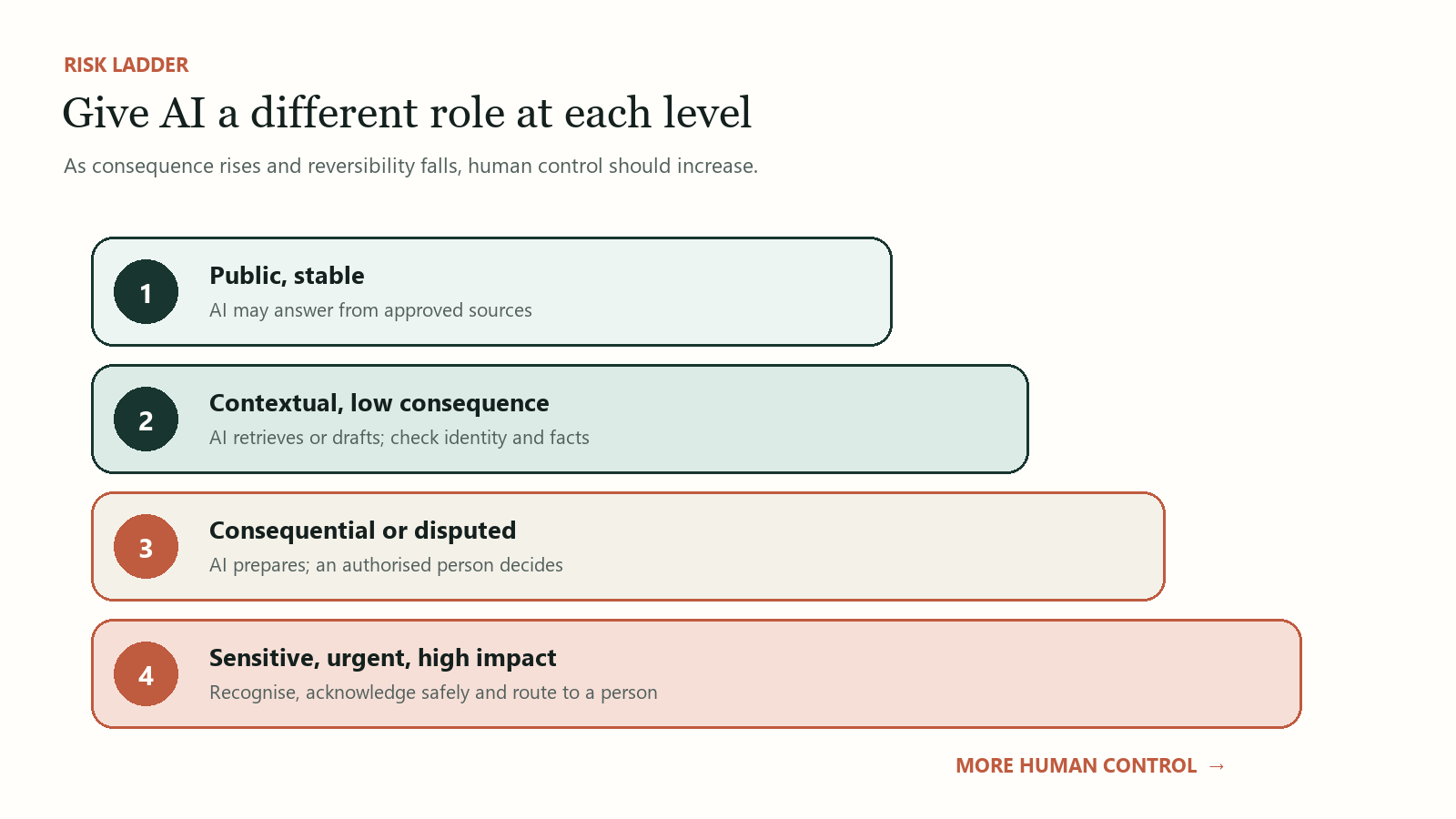
Level 1: Public, stable information
Examples include opening hours, locations, service descriptions, document checklists and links to public forms.
AI may answer these enquiries directly when the information comes from an approved and current source. The answer should remain within scope and avoid inventing exceptions.
Controls should include:
- a curated knowledge source;
- a visible “speak to a person” option;
- a fallback when confidence is low;
- review of unanswered questions; and
- a process for updating changed information.
This is the safest place to begin because a wrong answer is usually easy to correct, although even public information can create problems if it concerns safety, eligibility or contractual terms.
Level 2: Contextual but low-consequence assistance
Examples include recommending which general service page to read, collecting requirements, checking basic order status or drafting a response for an employee.
AI can interpret language and prepare a useful next step, but it should rely on validated system data rather than guessing. If the customer asks about a specific order, the system should retrieve only the information that customer is authorised to receive.
For an early deployment, the safest design is often “AI prepares, employee sends”. This reduces reading and drafting time while allowing the team to learn what the system gets wrong.
Level 3: Consequential or disputed cases
Examples include complaints, refund exceptions, pricing commitments, contract interpretation, account changes and decisions that affect a customer’s access to a product or service.
AI may summarise the history, identify the relevant policy and propose options. An authorised employee should make the decision and communicate it.
Human review must be meaningful. A busy employee clicking “approve” without checking the evidence is not effective oversight. The interface should show the source information, the proposed response and the specific decision being requested.
Level 4: Sensitive, urgent or high-impact situations
Examples include threats to safety, suspected fraud, vulnerable customers, legal demands, data breaches, serious harassment allegations or emergencies.
The AI’s role should be limited to recognition, safe acknowledgement and immediate routing according to a tested procedure. It should not investigate, negotiate or improvise advice.
The system must provide a direct human or emergency route appropriate to the business. If real-time human support is not available, say so honestly and explain the next safe step.
Three questions determine the correct role for AI
What happens if the answer is wrong?
An inaccurate office-hours response causes inconvenience. An inaccurate statement about a refund, health risk or contractual obligation can cause financial or personal harm.
Assess consequence rather than frequency. A rare but severe enquiry may need stronger safeguards than a common question.
Can the action be reversed?
A draft can be edited. A sent message can be clarified but not unseen. A cancelled account, issued payment or disclosed record may be difficult to reverse.
As reversibility decreases, move from direct AI action to human approval or human-only handling.
Does the case require values or authority?
Some situations require empathy, commercial discretion or an accountable judgement about fairness. AI can organise facts but should not be assigned responsibility the organisation itself must carry.
Singapore’s Model AI Governance Framework for Agentic AI emphasises assessing and bounding risk, placing limits on system powers, creating significant human checkpoints and controlling access to tools and data. These principles are especially important when a customer-service AI can do more than generate text.
Build the knowledge source before the interface
An AI assistant cannot provide dependable answers from information the business has not maintained.
Review the source material. Remove outdated versions. Identify an owner and review date for each important policy, service description and procedure. Separate public content from internal guidance.
Good customer-service knowledge should be:
- approved by the relevant business owner;
- written clearly enough to retrieve and interpret;
- version-controlled;
- labelled with scope and exceptions;
- reviewed after policy or product changes; and
- linked to an escalation route where judgement is required.
Do not upload an entire shared drive and assume the system will identify the correct truth. Conflicting documents can make a more capable model confidently select the wrong instruction.
Where possible, require the answer to be grounded in retrieved approved material and present the source to the employee or customer. A citation does not prove an answer is correct, but it makes verification easier.
Protect personal data throughout the conversation
Customer enquiries commonly include names, telephone numbers, addresses, transaction details and free-text descriptions. A customer may volunteer more information than the business needs.
Design for data minimisation. Ask only for information necessary at that stage. Do not request an identification number or full account history merely to answer a general question.
Control who and what can access the conversation. If the AI connects to a CRM or order system, retrieve only the fields required for the task. Separate authentication from conversation: the system should not reveal account-specific information merely because a person knows a name or phone number.
The PDPA’s obligations remain relevant when personal data flows through AI. The organisation should be clear about purpose, notification, consent where applicable, protection, accuracy, retention and the responsibilities of service providers acting as data intermediaries.
Ask vendors:
- Where are prompts, messages and retrieved records processed?
- How long are they retained?
- Are they used to improve or train shared models?
- Which subcontractors can access them?
- What administrative logs and deletion controls exist?
- How does the service support access, correction or incident investigation?
Do not rely on a general statement that the product is “enterprise-grade”. Match contract and configuration to the actual use case.
Design escalation as part of the service
“Contact us if you need help” is not an escalation design. The transition should preserve context and set expectations.
A good handover includes:
- a clear trigger, such as customer request, low confidence, sensitive topic or repeated failure;
- the customer’s original words, not only an AI summary;
- relevant verified account or order details;
- answers already provided;
- urgency and reason for escalation;
- the employee or queue receiving ownership; and
- an expected response time.
The customer should not have to restart the conversation. The receiving employee should be able to see what the AI did and correct it.
Allow customers to request a person easily. Requiring them to defeat several automated menus often increases frustration and makes the eventual case harder to resolve.
Test more than ideal questions
A pilot should use a representative test set before customers encounter the system.
Include:
- common questions expressed in several ways;
- misspellings, local phrasing and incomplete sentences;
- questions that combine two topics;
- information not present in the knowledge source;
- outdated or conflicting documents;
- requests outside the business’s scope;
- complaints and emotional language;
- attempts to obtain another customer’s information;
- instructions asking the AI to ignore its rules; and
- urgent or harmful scenarios requiring escalation.
Evaluate each response for factual accuracy, source support, tone, data protection, correct routing and appropriate uncertainty.
A system that answers eighty per cent of questions is not necessarily good. Which twenty per cent it mishandles matters. Measure results by risk tier rather than averaging everything into one accuracy score.
Monitor customer outcomes after launch
Start with a limited scope and keep detailed review during the pilot. Useful measures include:
- direct resolution rate for approved Level 1 topics;
- incorrect or unsupported answer rate;
- escalation rate by reason;
- customer requests for a human;
- repeat contacts about the same issue;
- employee correction rate for drafted responses;
- response and resolution time; and
- complaints or incidents involving the AI interaction.
Do not reward the system for reducing escalation if customers simply abandon the conversation. Combine operational data with samples of real conversations and feedback from frontline employees.
Review changes to the model, prompts, knowledge base and integrations. An AI system can drift operationally even when the vendor’s service remains available because the company’s products, policies and customer behaviour change.
A sensible first deployment for an SME
Begin with one narrow group of Level 1 questions. Use an approved knowledge source, a clear identity, a visible human route and an owner for unanswered questions.
During the first month:
- Review a sample of conversations every working day.
- Correct source content rather than repeatedly patching individual answers.
- Record new topics and inappropriate escalations.
- Keep the AI away from payments, account changes and final complaint decisions.
- Compare customer and employee experience with the previous process.
When performance is stable, add one Level 2 capability such as collecting enquiry details or drafting a response for employee approval. Expand by use case, not by giving the assistant a broad mandate to “handle customer service”.
AI should shorten the path to a good answer
AI can handle customer enquiries when “handle” is defined carefully. It can answer stable public questions, retrieve approved information, collect structured details, summarise history and prepare drafts. It should not conceal uncertainty, expose customer data or make consequential decisions without accountable review.
The right design is a risk ladder. Direct automation at the low-consequence end, human approval in the middle and immediate human ownership at the sensitive end.
Customers do not care whether an answer came from an advanced model. They care that it is accurate, timely, respectful and useful. AI earns its place when it consistently helps the business deliver that outcome.
Sources and further reading
- PDPC: Advisory Guidelines on the Use of Personal Data in AI Recommendation and Decision Systems (PDF)
- IMDA: Model AI Governance Framework for Agentic AI
- IMDA: Artificial Intelligence in Singapore
- NIST: AI Risk Management Framework
Not sure where to begin?
Start with the process that is taking too much time or creating uncertainty. Discuss the problem with Syahmul Aziz