WhatsApp is often the most convenient place for a customer conversation to begin. It is familiar, fast and personal. A prospect can send a photograph, ask a question and receive an answer without learning a new system or waiting on hold.
For a small team, that simplicity is a genuine advantage. The problem begins when WhatsApp becomes not only a communication channel but also the company’s unofficial customer database, task list, sales pipeline and service history.
At that point, important work depends on who owns a particular phone, who remembers the conversation and who notices the unread message. A customer can receive a quick first reply but still be forgotten before quotation or follow-up. Management sees activity but cannot see the pipeline.
Moving to a customer relationship management system, or CRM, does not mean abandoning WhatsApp. It means separating the conversation channel from the operational record. Customers can continue using the channel they prefer while the business gains ownership, visibility and follow-through.
This guide explains when an SME has reached that point and how to make the transition without building an oversized system.
WhatsApp is a channel, not a complete operating system
The WhatsApp Business app offers useful features for small businesses, including a business profile, catalogues and tools that help customers initiate conversations. These features can support professional communication and make a business easier to reach.
However, the core unit remains a conversation. A proper enquiry process needs more than a conversation history. It needs structured facts and accountable next actions.
For every serious enquiry, the business may need to know:
- who the customer is and how they heard about the company;
- what product, service or problem they are asking about;
- whether the enquiry is qualified;
- which employee owns the next step;
- what was promised and by when;
- whether a quotation was issued;
- why the opportunity was won, lost or paused; and
- what consent or communication preferences apply.
Some of this can be typed into a message, but that does not make it consistently reportable. A search for “quotation” will not reliably produce a sales forecast. A star on a message does not tell a manager which enquiries are overdue.
The question is therefore not whether WhatsApp is good or bad. It is whether the business can still control the work that begins there.
Seven signs that WhatsApp alone is no longer enough
1. Enquiries live on personal devices
If customer history sits inside one employee’s phone, the company’s service continuity depends on that person being available. Leave, resignation, illness or a device problem can interrupt the relationship.
A business-owned WhatsApp account is better than a personal account, but shared access alone does not solve ownership. The team still needs to know who is responsible for each case and what happens next.
2. Customers repeat information
A customer explains the request to one employee and then repeats it to sales, operations or finance. The issue is not merely inconvenience. Repetition signals that the business has no dependable shared record.
A CRM should preserve the essential context so the next employee can continue the conversation without making the customer reconstruct it.
3. Follow-up depends on memory
Employees scroll through chats at the end of the day, star messages or create private reminders. These habits work until volume rises or priorities change.
If there is no systematic way to identify enquiries awaiting a response, quotation, approval or customer decision, missed follow-up is an expected process outcome rather than an occasional mistake.
4. Management cannot answer basic pipeline questions
How many new enquiries arrived this month? Which services attracted them? How many reached quotation? How long did the first response take? Which opportunities have had no activity for seven days?
If answering these questions requires asking each employee or manually reading conversations, the business lacks operational visibility.
5. Different staff give different answers
Inconsistent pricing, preparation instructions, lead times or policies create rework and reduce trust. A CRM will not automatically fix unclear rules, but it can support approved templates, current reference material and a recorded approval path.
6. Customer details are repeatedly copied
Names, addresses and order details move from WhatsApp into spreadsheets, quotations, accounting software and delivery messages. Re-entry wastes time and introduces mistakes.
A connected enquiry record can become the controlled starting point for later documents and workflows. The goal is not to copy every chat into every system. It is to capture the reusable facts once.
7. The business cannot manage access and retention confidently
Customer conversations may contain personal data, photographs, addresses and commercial details. When information is scattered across personal devices and exports, the business may struggle to answer who can access it, why it is retained and how it will be removed when no longer needed.
Singapore’s PDPA applies to the organisation’s collection, use, disclosure and protection of personal data. Moving to a CRM does not create compliance by itself, but it can make access, purpose, retention and accountability easier to manage when configured properly.
The CRM readiness test
Use four dimensions to decide whether the change is justified.
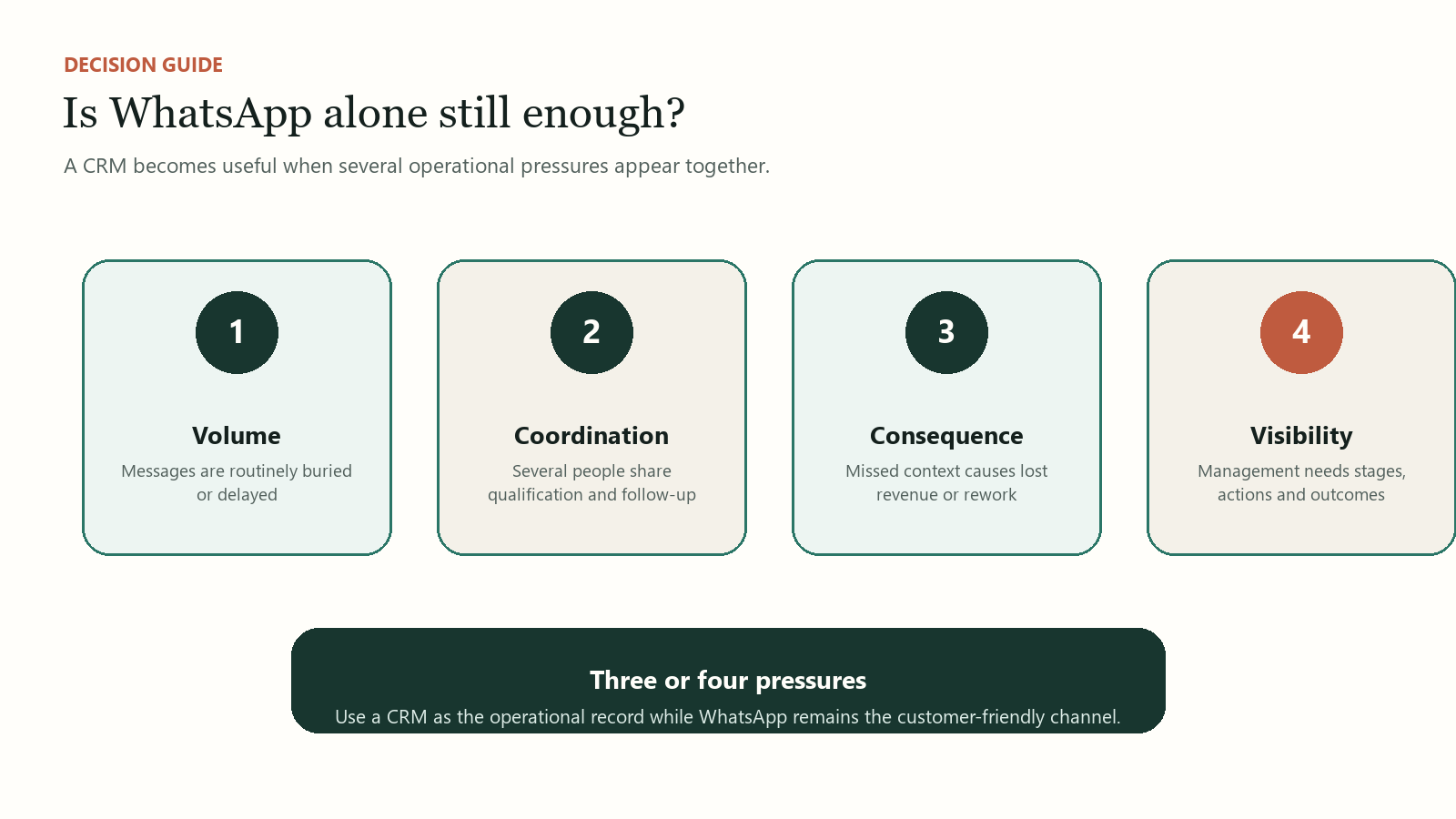
Volume. The team receives enough enquiries that messages are routinely buried or delayed.
Coordination. More than one person participates in qualification, quotation, fulfilment or service.
Consequence. Missing or misunderstanding an enquiry creates meaningful lost revenue, customer harm or rework.
Visibility. Management needs a consistent view of sources, stages, response times and outcomes.
If only volume is low and one person handles everything reliably, WhatsApp Business plus a simple shared tracker may still be sufficient. If three or four dimensions are present, a CRM is no longer corporate decoration. It is an operating control.
What a proper customer enquiry system should do
An SME does not need every feature advertised by a CRM vendor. It needs a dependable minimum workflow.
Capture the enquiry
An enquiry may arrive from WhatsApp, a website form, email, telephone or a referral. Each should create or update one customer and one enquiry record rather than producing disconnected duplicates.
The record should capture the channel and original message, while separating structured fields such as service interest, location, urgency and source.
Assign an owner and next action
Every active enquiry needs one accountable owner, a status and a dated next action. “Sales team” is not an owner. “Follow up soon” is not a dated action.
Ownership can change as work progresses, but the handover should be visible. A notification is useful only when the system also records who accepted responsibility.
Maintain a small number of meaningful stages
Avoid a pipeline with fifteen stages that employees will not update. A service SME may need only:
- New enquiry
- Qualification required
- Consultation or site visit
- Quotation sent
- Customer decision
- Won, lost or paused
Each stage should have a definition. For example, “quotation sent” means the document has been issued, its value is recorded and a follow-up date exists.
Preserve conversation context
The CRM should not force employees to paste every message manually. Depending on the chosen platform and integration, the system may link, synchronise or summarise relevant conversations.
Decide what needs to become part of the formal record. A joke or greeting does not need to populate the CRM. A confirmed requirement, approved price or promised delivery date probably does.
Support templates without becoming robotic
Templates can speed up acknowledgements, information requests and follow-ups. They should provide consistency while leaving staff room to address the customer’s actual situation.
WhatsApp also places expectations around opt-in, relevance and the ability for recipients to stop business messages. A CRM should record communication preferences and help the business avoid sending unwanted broadcasts simply because a contact number exists.
Produce useful management views
Start with operational measures rather than vanity statistics:
- median first-response time;
- enquiries without a named owner;
- active enquiries without a future action;
- conversion from enquiry to quotation and from quotation to sale;
- time spent in each stage; and
- common reasons for loss or delay.
These measures reveal where the process needs attention. The number of messages sent does not.
Do not migrate chaos into the CRM
A CRM project often fails because the business focuses on importing contacts before defining the process.
Begin with a current-state map. Follow five recent enquiries from first contact to outcome. Identify the information that was genuinely needed, the handovers that occurred and the points where work stopped.
Then agree on:
- the minimum required fields;
- the stage definitions;
- ownership rules;
- response and follow-up expectations;
- what information belongs in the formal record;
- who may see or export customer data; and
- how duplicate, stale and closed records are handled.
Only then should the business configure a tool. Otherwise, employees will create workarounds inside the new system and continue maintaining private spreadsheets.
A low-disruption migration plan
Phase 1: Define the pilot
Choose one team, service line or enquiry source. Use a four- to six-week period long enough to observe real variation.
Record a baseline: enquiries received, response time, missed follow-ups, time spent preparing updates and conversion to the next meaningful stage.
Phase 2: Configure the minimum record
Create only the fields, stages and views needed for the pilot. Set access according to job responsibilities. Use company-managed accounts and enable available security controls.
Prepare a simple rule for WhatsApp: when a conversation becomes a genuine enquiry, create or update the CRM record and assign the next action. The exact trigger might be a request for quotation, a confirmed requirement or a qualifying answer.
Phase 3: Run both visibility and exception checks
During the pilot, review overdue items twice a week. Look for duplicates, missing fields, unclear ownership and conversations that do not fit the designed stages.
Do not judge success only by whether the integration ran. Ask whether employees can find the right context, whether customers repeat themselves less and whether managers can act on the pipeline view.
Phase 4: Improve before expanding
Remove fields nobody uses. Clarify stage definitions. Adjust notification volume. Fix access problems and document the operational procedure.
Expand only after the first group uses the system consistently. A smaller CRM with trusted data is more valuable than a sophisticated platform full of incomplete records.
Common mistakes to avoid
Buying for the future instead of the present. An SME may select a complex enterprise CRM because it could support every possible future process. The current team then avoids it because routine work takes too many clicks.
Treating integration as strategy. Connecting WhatsApp to a CRM does not decide what becomes a lead, who owns it or how quickly the business should respond.
Importing every historical contact. Old numbers without purpose, consent, context or current value add clutter and risk. Migrate records according to a defined business need and retention approach.
Measuring employee activity instead of customer progress. Counting calls and messages can encourage busywork. Measure movement, timeliness and outcomes.
Removing the human tone. Customers chose WhatsApp partly because it feels direct. Automation should remove administrative friction, not turn every conversation into a rigid script.
WhatsApp can remain the front door
The decision is not “WhatsApp or CRM.” WhatsApp can remain a convenient front door while the CRM becomes the operational memory behind it.
The business is ready for that separation when customer work spans people, follow-ups are easy to lose and management needs more than a scrolling chat history. Start with one clear workflow, one accountable owner and a small number of required fields. Connect the channel only after those rules make sense.
The best customer enquiry system is not the one with the longest feature list. It is the one that helps the team respond with context, keep promises and know what must happen next.
Sources and further reading
- WhatsApp Help Center: About Your Business Profile
- Meta: Ways to Manage Your Business Chats on WhatsApp
- PDPC: Data Protection Obligations
- IMDA: SMEs Go Digital
Not sure where to begin?
Start with the process that is taking too much time or creating uncertainty. Discuss the problem with Syahmul Aziz